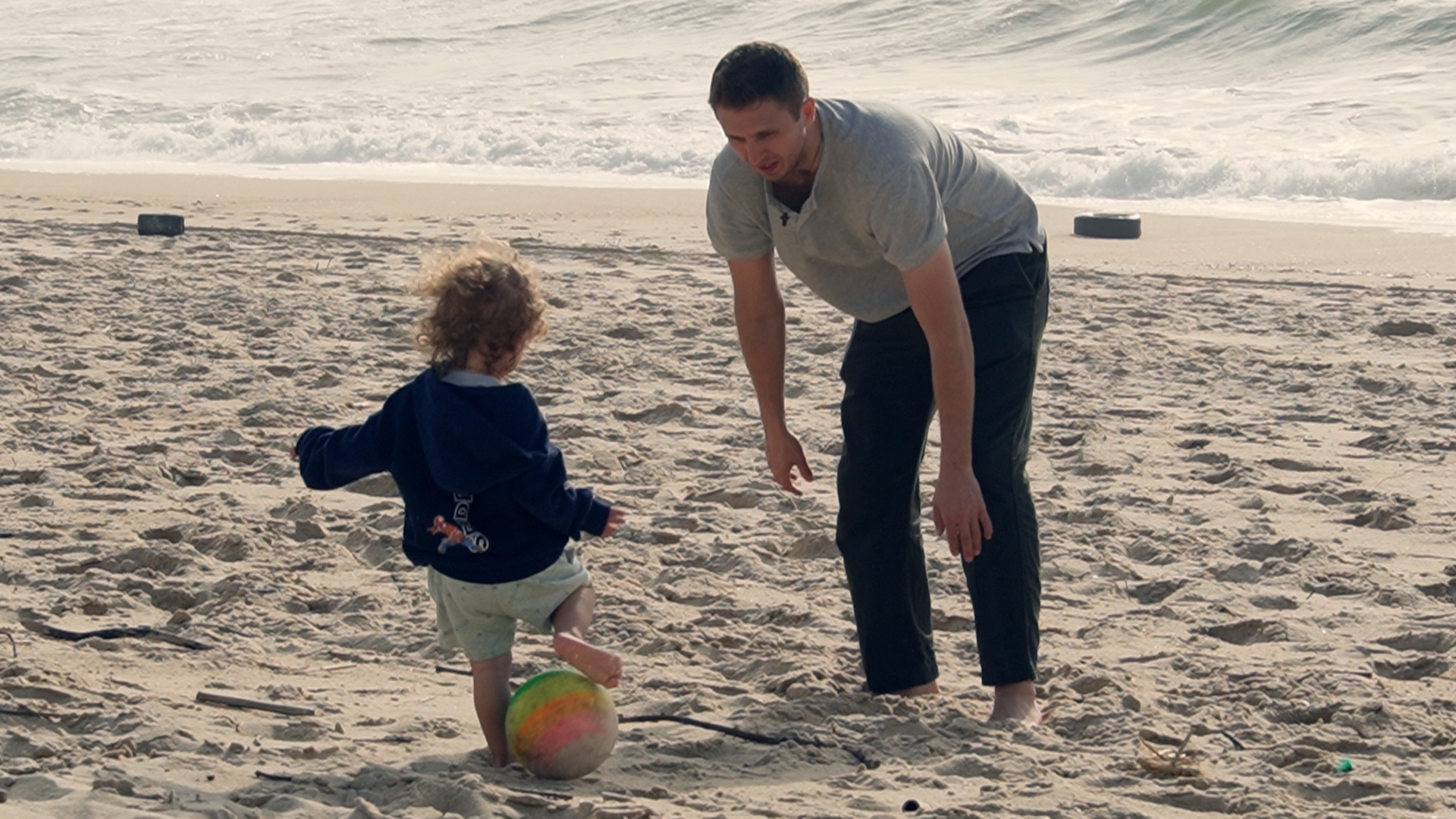
Four months after we left Scotland for central Portugal with two young children, this is what has changed in them, in us, and in the texture of an ordinary week.
My son turned two. He was born in Scotland. One year ago, almost exactly to the day, we celebrated his first birthday in our old house somewhere near Glasgow, and the cake sat on the same kitchen table where we had been having the same conversation for months. Whether we were going to do it. Whether we were going to leave. Whether central Portugal, the country we had been quietly thinking about for two years, was actually the place we were meant to be raising our children, or whether that was a thought we would never act on.
That first birthday was the part of the year I now think of as the limbo. We were still in Scotland in body. We were already somewhere else in mind. There is a particular tiredness to a year like that, where the place you are living and the life you are imagining have begun to disagree with each other, and you carry both of them around at the same time.
This week he turned two. Here. In a stone house in central Portugal, with the windows open, with the older sister leaning in to help him blow out the candles, with the kind of warmth in the air that does not exist in Scotland in May. A year between those two birthdays. He has no idea he is the way I have come to measure the distance, but he is.
The year of waiting, and the month it ended
Scotland is one of the most beautiful countries I have lived in. I want to be honest about that before I say anything else. The light, the green, the particular weight of the air after rain. None of that gets undone by leaving. We did not move because Scotland was wrong. We moved because we had begun to suspect that the place we were supposed to be raising our children was somewhere else, and the suspicion would not leave us alone.
The first month here was, by every honest measure, hectic. Moving anywhere with two young children is not the easy part of anything. We were trying to settle a house we had only briefly seen, navigate a language we were still learning to apologise for, and answer questions we had not realised we would have to answer. How and where would the children integrate. Which classes would take them. Whether they would be lonely. Whether we had taken something familiar away from them too soon.
I will not pretend the first weeks were peaceful. They were not. I do not think any honest account of moving with young children should pretend otherwise. Bureaucracy is heavy here, in the ways every account already names, and on top of it there is the more private bureaucracy of trying to make a house feel like a home while everything around you is still cardboard.
What surprised me about how this country treats children
The thing that took me longest to get used to, and the thing that has changed how I feel about being here more than anything else, is the way the people in central Portugal love children. Not their own children. Anyone's. A child you have never met before will be greeted by a stranger at the bakery the way a relative might. There are hugs. There are kisses. There is conversation directed at the child as if the child is, quite obviously, a person worth speaking to.
In the supermarket queues. In the village square. At the doctor's, at the market, at the bus stop. The first weeks, I did not know what to make of it. In the country I came from, you do not touch a child you do not know. You do not address them too warmly. There is a particular kind of restraint, which I had grown up with and not questioned, that does not exist here.
I have come to believe, slowly, that the restraint I grew up with is the strange thing, and what happens here is the older thing. Children are part of the public world. They are addressed as part of it. They are loved as part of it, openly, by people who have no obligation to love them. I cannot describe the effect this has on a child without resorting to language that sounds sentimental, so I will simply describe what I see. My children move through the world expecting warmth. They expect to be greeted. They expect to be spoken to as someone. That expectation is the thing I most wanted to give them, and I did not know it was the thing until I saw it being given.
My children move through the world expecting warmth. That expectation is the thing I most wanted to give them, and I did not know it was the thing until I saw it being given.
The way they spend their days
The other thing that has changed, and that I notice every time I take a photograph of the children and compare it later to a photograph from a year ago, is where they actually are during a day.
They are outside more than they have ever been. By a significant margin. Not for any reason we have organised, not as a parenting strategy, but because outside here is where life happens. They explore the village. They find insects, which they pick up and ask me to identify in a language I do not yet have the vocabulary for. They climb things, they wade into streams, they crouch over patches of ground that, to an adult, contain nothing at all. They are absorbed by detail in a way I have only seen in children who are allowed enough time and space to be bored first.
They are also, separately, more open. I do not know quite how to phrase this without it sounding like a parent overinterpreting. But the daughter who was once quiet around new people now walks up to the older neighbours and tries to speak. The son who is two reaches up to anyone who will smile at him. They have absorbed the assumption that the world is full of people who like them, and they act on that assumption without being asked to.
I think this is what people mean, in the older parts of the longevity research, when they talk about social embeddedness as a health variable. I think children who grow up assuming that strangers are mostly kind grow into adults who carry less of a particular kind of weariness through their lives. I cannot prove it. I notice it.
What I would tell someone considering this with young children
People write to me asking whether moving to Portugal with young children is worth it. I want to answer that question honestly, because the polished versions of it that exist on the internet did not help me when I was the one writing those emails.
The first answer is that it is harder than the brochure suggests. The paperwork is real. The language is real. The loneliness of the first weeks is real. The doubt is real. There are mornings, even now, when one of the children asks for something I cannot give them in this country, and I feel the cost of the decision sitting in my chest. I do not want to pretend that goes away. I think it never quite does. You learn to carry it.
The second answer is that I would do it again. Without hesitation. Not because central Portugal is a perfect place. There are no perfect places. I would do it again because the texture of the day my children get to have here is, by my measure, closer to what childhood is supposed to be than the texture of the day they were having in our old life. Slower. More outdoors. More embedded in the lives of the people around them. More loved by strangers in small ways.
The third answer is the one I find hardest to phrase. I think children who grow up in places where they are visibly loved by the public world grow up differently than children who grow up in places where they are not. I think this difference will outlast me. I think this is the part of the decision I will be most glad of, in twenty years, when everything else has faded.
Four months on
This week we made a cake. We decorated the house, by six hands instead of four this year, the older sister helping. We let the son sleep late, which he does not do often. He woke when his sister came in to wake him, because she could not wait. He understood, this year, that the candles were for him. He understood, sort of, that the cake was something to celebrate, even if the meaning of celebration is still mostly the meaning of having icing on your face.
A year before, in another country, we had been holding a cake on a different table, wondering whether we would ever do this. We did. This is what doing it has looked like. Slower than we thought, harder than we thought, and more full of small public kindness than anything I have ever been part of.
If you are reading this from somewhere uncomfortable, sitting with the same question we sat with a year ago, I do not think the answer is necessarily central Portugal. But I do think the discomfort is worth paying attention to. And I think there are more places in the world than you have been told there are where children are loved openly by strangers, and where the texture of an ordinary day is allowed to be slow.
We are still building the life. The land we have been looking at is one of the things still taking shape, somewhere up in the hills near Espinhal. I will write about it when there is something worth writing. For now, the cake is on the table, the candles are out, and my son is two.